
Binondo Food Walk: A Private Half-Day in Manila’s Chinatown
Most people meet Manila twice. Once on the way in, tired, and once on the way out, waiting for a flight south or out. Both days tend to get wasted in a hotel lobby. Binondo is the fix. It sits just across the Pasig River from Intramuros, it rewards a few hours rather than a full day, and you can eat very well there for very little money.
Binondo was set up by the Spanish in 1594 on the far bank of the Pasig River, for Chinese traders who were not allowed to live inside the walled city. It is often called the oldest Chinatown outside China. Four centuries later it is still a working trade district, not a theme park. Gold shops line Ongpin Street. Delivery carts squeeze past church steps. Family restaurants that opened two or three generations ago still cook in front of the customer.
This guide covers what to eat, when to go, and how we fit a private Binondo walk into a real trip.
What to eat, in roughly the right order
A good walk starts light and ends sweet. Here is the order our guides usually follow.
Dumplings first. Small dumpling houses around Yuchengco Street make them to order. Dong Bei Dumpling is the one most locals point to. Try the kuchay (chive and garlic) dumplings and watch them being folded at the counter. Tea is usually on the table before you sit down.
Fresh lumpia. Hokkien-style spring rolls are the dish Binondo is known for. New Po Heng Lumpia House is a small family shop on Carvajal Street. The rolls are soft, not fried, and filled with tofu, minced pork, seaweed, crushed peanuts, carrot and cabbage. Add garlic and vinegar if you like.
Fried chicken and kiampong. Sincerity Cafe and Restaurant is known across Manila for its fried chicken. Order a half, then add kiampong (sticky rice with peanuts) and a fried oyster cake to share. This is the stop where people stop saying “just a little.”
Siopao and hopia to take away. Steamed buns (siopao) are an easy walking snack. For hopia, the flaky pastry with sweet filling, the purple ube version is the one to bring home. Eng Bee Tin on Ongpin is the shop most people know for hopia. Hopia travels well, so it makes a sensible gift for the next hotel.
Four or five stops is enough for most groups. More than that and the last two become a chore.
What else you will see on the way
A food walk in Binondo is also a short history walk, because the restaurants sit between the landmarks.
- Binondo Church, the Minor Basilica of San Lorenzo Ruiz. Lorenzo Ruiz, the first Filipino saint, served here as an altar boy. The church dates from 1596 and has been rebuilt more than once.
- Ongpin Street, the main spine of Chinatown, with its gold shops, herbal stores and tea sellers.
- Santa Cruz Church, at the edge of the district, first built in 1619 and rebuilt after the Second World War.
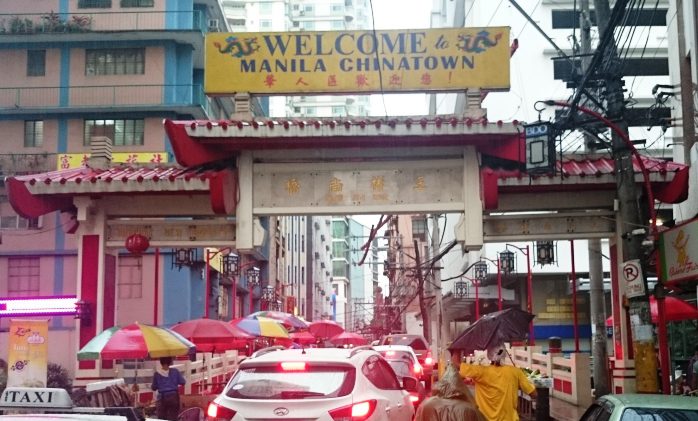
- The Filipino-Chinese Friendship Arch, the gateway most people photograph on the way in.
Guests who want more Chinese-Filipino history can add the Chinese Cemetery, a short drive north. The family mausoleums there are large, detailed and unlike anything else in the city. It works best as a separate stop after lunch, not squeezed in at the end.
When to go
Time of day. Start between 8:00 and 9:00. The streets are busy but not yet hot, and the dumpling and lumpia places are cooking for their regular morning trade. By 13:00 the heat and the traffic both build, and most people are full anyway.
Day of week. Tuesday to Saturday is the safest window. Several older family places close early on Sunday or skip it, and on Mondays some of the Manila museums and sites on the wider city tour are closed. We check opening hours the day before, because small family restaurants change them without much notice.
Rain. In the wet season, roughly June to October, short heavy showers are common in the afternoon. A morning walk usually stays dry. We carry umbrellas, and most stops are indoors.
Chinese New Year. In 2027 it falls on 6 February. Binondo is at its most colorful then, with dragon dances and firecrackers, and it is also at its most crowded. It is worth seeing once. Do not plan it as a quiet food walk.
How we fit it into a trip
Binondo is most useful on the days that are otherwise lost.
Arrival day. If your international flight lands early, a short walk after check-in keeps you awake until a normal bedtime. Two or three stops is plenty. Jet lag and a full fried-chicken lunch do not mix well.
Before a domestic flight. This is where Binondo works best. A morning food walk, lunch, then straight to the airport. For a domestic flight we leave three hours before departure. Manila traffic can make the airport drive much longer than the map says, so that buffer is not optional. An early-afternoon flight to Palawan, Bohol or Cebu leaves room for a full morning in Chinatown. A flight before noon does not, and we will tell you so.
Last day. Hopia, tea and dried fruit from Binondo are better gifts than anything at the airport. A late-morning walk before a night flight home is a good way to finish.
With the full city tour. Our Manila full-day tour covers Intramuros, Fort Santiago, San Agustin Church and the Chinese Cemetery, with hotel pick-up at 08:30 and return around 16:30. If food matters more to you than museums, we can swap part of that day for a longer Binondo walk.
Practical notes
- Walk, do not drive. The streets are narrow and traffic is slow. Your private driver drops you at the edge of the district and meets you at the end.
- Cash. Many small places take cash only. Bring small notes in pesos.
- Shoes and water. Closed, comfortable shoes. Pavements are uneven and sometimes wet.
- Bags. Keep them in front in crowded lanes, as you would in any busy market.
- Dietary needs. Pork is in a lot of dishes. Tell us in advance if you eat halal, vegetarian or need to avoid peanuts, and we will choose stops that fit.
- Group size. Some of the smaller places seat ten people at most. Private walks work best for two to eight guests. For a larger group, tell us the size and we will plan the stops around it.
FAQ
How long does a Binondo food walk take? About three to four hours for four or five stops, including walking time between them.
When should we go? Start between 8:00 and 9:00, Tuesday to Saturday. That window is cooler, and the dumpling and lumpia kitchens are already cooking.
Can we do Binondo before a domestic flight? Yes, if the flight is after early afternoon. We leave three hours before a domestic departure, so a morning walk fits before a midday airport transfer.
Is Binondo good for families and groups? Yes. Private walks work best for two to eight guests. Larger groups need a different stop plan, because some of the smaller places seat about ten people.
Plan it with us
Tourismo Filipino plans private trips across the Philippines. We are Manila-based, so Binondo is close to home for our guides. We plan the walk around your flights, your hotel and what you actually like to eat. Read our Binondo walking food tour page and our Manila guide, then send us your dates.
Call +63-917-175-6678, or email [email protected]. You can also plan your trip online.